
Do you know it is possible to determine the health of a rotating machine & overcome the problem of machine failure?
This is done via monitoring or gathering various machinery parameters like Vibration, Temperature, Ultrasound, Magnetic Flux, etc, and then analyzing them to detect the faults if developing. This very process is also known as Condition Monitoring.
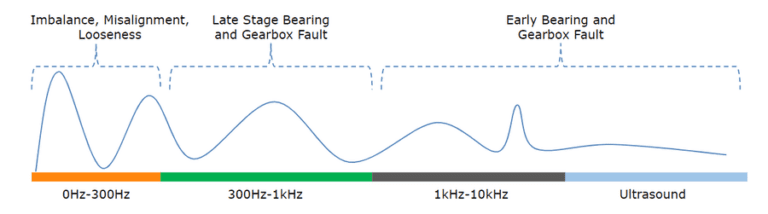
Here in this article, you will be knowing an overview of the 4 major faults/failures that produce abnormal machine vibrations. We are mentioning the term abnormal or unusual vibration because all types of equipment produce a certain amount of vibration which is unavoidable in nature. The concern arises when these pieces of equipment experience the vibration beyond their defined or threshold value.
In pumps, motors, and most other rotating equipment, the four most common faults or causes of abnormal vibrations are misalignments, looseness, imbalance, and bearing wear. If we talk about the reasons for these machine faults, then they may arise due to Human error, Operator error, or Maintenance error. All these can cause increased power consumption, vibration, and stress on shafts.
1. Misalignment
Pump shaft misalignment occurs when one shaft or surface is moved from its desired position. These movements can lead to misalignment in the entirety or partial sections of a pumping system.
Misalignment in pump shafts can also result in an increase in resultant forces that change the angles and orientations into new resultant load directions.
Misalignment may be caused by:
- Relative Movement, thermal growth, or expansion
- Strain, attached piping runs can force equipment out of alignment
- Torsional Movement, initial high torque caused during startup
- Settling, base plate settles to lower position
- Misboard Coupling, manufacturing defect
2. Imbalance
Pumps can at times seem as if they are misaligned, have bad bearings, or are overheating, but the cause is often an imbalance in the pump assembly or another component.
Imbalance also causes vibration and heat buildup. Impellers should be precision balanced, which has a huge impact on the life of the pump bearings.
An imbalance may be caused by:
- Eroded impeller blades
- Problems with motor rotors
- Improper bearing installation
- Bent shaft
3. Looseness
The shaft, foundation, or a component may become loose. This causes forces that lead to excessive vibration and increases the wear in the bearings and seals.
It may also cause baseplate problems, including soft foot; loose bolts; cracks in a frame; or improper fit between components, including impeller clearances.
If not identified and corrected, looseness will shorten the asset’s and other components’ lives, ultimately causing failure.
Looseness may be caused by:
- Improper installation
- Manufacturing defects
- Baseplate issues
- Improperly torqued fasteners
- Underlying vibration from other faults
4. Bearing wear
Bearing wear is usually caused by other factors acting on the bearings. If the bearings are failing prematurely, the other low-level faults (imbalance, misalignment, or looseness) may be the cause.
Causes of bearing wear are:
- Lubrication Failure
- Contamination
- Improper Mounting
- Corrosion
- Electric Damage
Final Words
So, this was brief on various rotating/reciprocating machine faults that result in abnormal machine vibrations. It’s important to regularly inspect the industrial equipment in order to identify these faults and fix them before they result in the complete machinery breakdown.
If you are a maintenance professional inside a manufacturing plant, then you would be performing the scheduled based maintenance, as known as Preventive Maintenance to avoid or fix these machinery faults.
But this might be difficult due to the lack of machine insights.
The solution to the above problem is using better a maintenance alternative like Predictive Maintenance which allows you to gain full machine insights and helps to plan or prioritize your maintenance in a better way.